Showing posts with label birds. Show all posts

Wednesday, April 9, 2014

Mallorca, for Birders and Bicyclists...

Beside being a favorite destination for bicyclists, Mallorca is also a favorite for birders. The island is both a stopover for European birds migrating to and from Africa, as well as being home to many resident species. In total over 300 species of birds have been seen on Mallorca, and early spring is a perfect time to photograph birds. Once the birds begin nesting in mid-April and May, they become more secretive and will be much harder to spot. In addition the sunlight in late spring means an even earlier sunrise, when birds are most active, and harsher contrast in your images once the sun is up, as well as a greater likelihood of un-sharp images due to heat haze. Cool cloudy days with occasional sprinkles are best, and as luck would have it that was the weather I had on my first day out.
A problem when traveling by car on Mallorca is that it is often impossible to stop and photograph safely due to the narrow roads, and the many cyclists and cars. So my first photo stop was an early morning at the Cap de Formentor on the northwest point of Mallorca before the cyclists and tourists had taken over the roads. This allowed me stop almost anywhere I liked without taking any risks, and from the car I was able to photograph the following species:


This blue rock thrush was taken from the parking lot at the Formentor Lighthouse, it's not a great shot, but they are shy birds and they simply refused to come any closer.


Another species that can be seen easily but not photographed well from the lighthouse are the shearwaters that glide over the water's surface about 300 meters below. I won't make a guess on which species of shearwater these are. In Sweden Twitchers (Birders) become ecstatic when they see a shearwater at 1000 meters, which then leads to endless discussions on the internet birding forums on which species it might have been...


In the valley forests on Formentor red-legged partridge can be see around almost every corner, unfortunately they run for cover when you pull over to take a picture, I think they are more used to shotguns than Canons. This one was far enough away to not be bothered by my stopping.


During a visit to the summit of Sa Calobra this cinereous vulture circled over in the drizzling rain, but the picture doesn't do justice to this magnificent bird, so I am also including a picture I took of the same species while visiting mainland Spain a few years earlier... 

My cycling colleague Olof Hagander who joined me on the trip to Sa Calobra later recalled the scene in the following way:
"Sa Calobra revisited... 45kph winds, rain, under an olive tree a goat cowers while a black vulture circles above... Mordor"


And finally along the southwest coast, in the meadows and farmlands there are countless other LBB's (little brown birds) like this crested lark


And the European greenfinch


Most of these shots were taken with the Canon 7D+ 800/5,6, but a 300/2.8L with 2X extender or the 500/4 +1.4X extender would also work well. If you are only interested in birding your options are far greater, since there are many wildlife sanctuaries with hides which provide good views over wetlands and meadows, although not with the same proximity that a photographer demands.

Wednesday, October 9, 2013

Time to Head South...


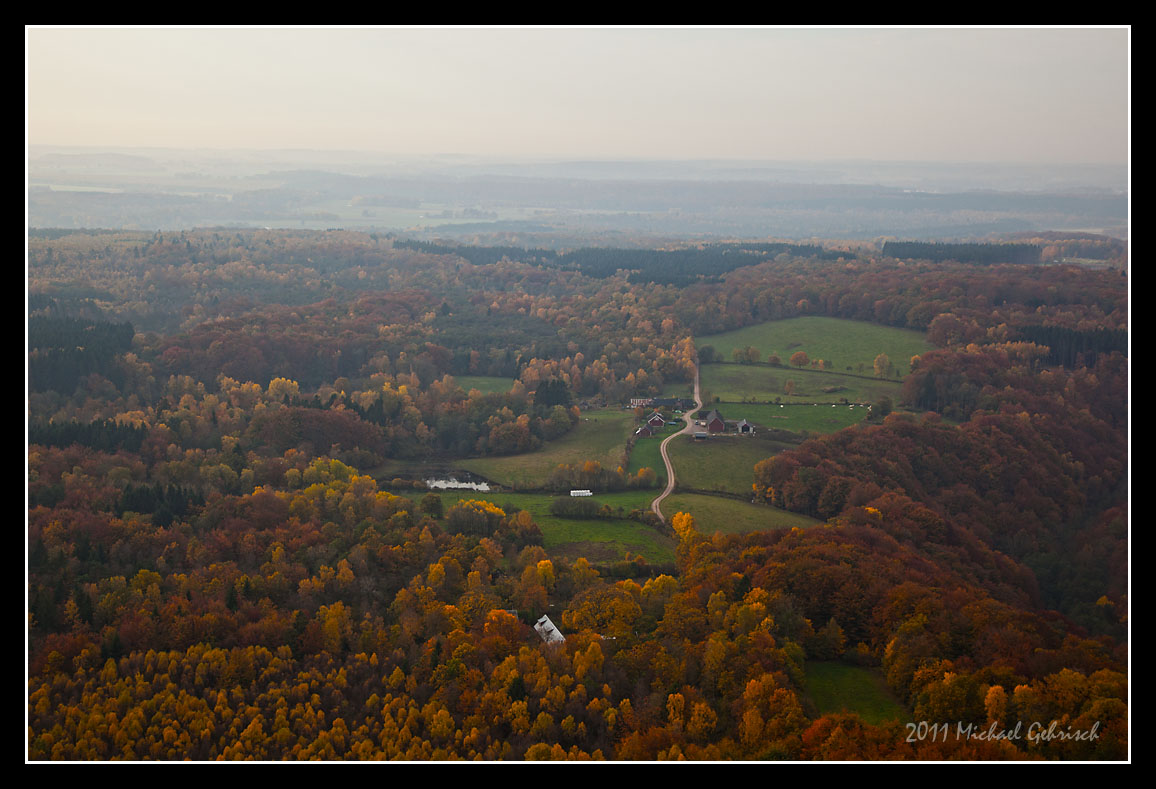
I have mixed feelings about fall; I love the changing colors of the foliage...


Once again the trees are filled with unusual small birds looking for spiders and tasty bugs. The photo-opps are as close as the back yard; just hang a camouflage net in the back door, lie down on the living room floor and wait for the visiting common redstart to patrol the lawn.


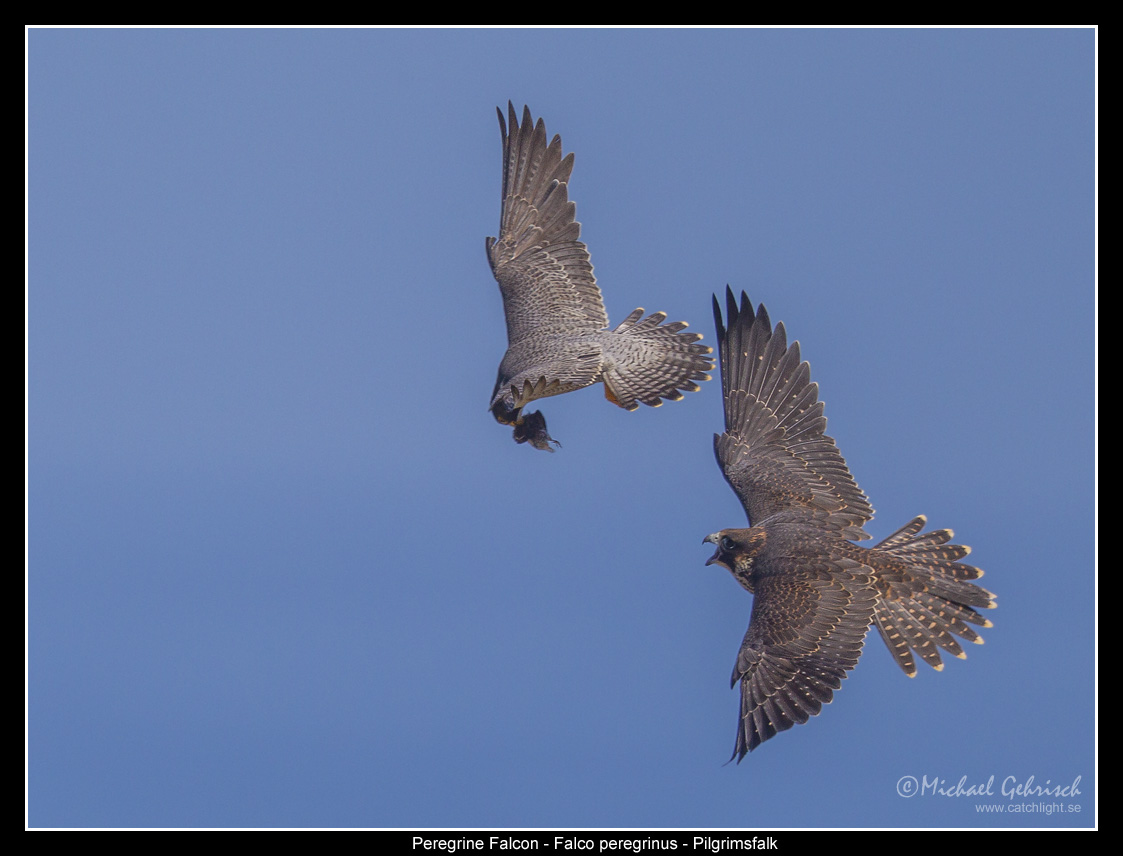
Or head to the southwest tip of Sweden together with hundreds of amateur ornithologists and watch the fall migration from Kolabacken at the Falsterbo Golf Club. As countless thousands of songbirds head south, thousands of birds of prey like peregrine falcons, hobbies, and sparrow hawks follow their food supply on a perilous journey over southern European. A greater risk than the peregrine falcon are the hunting grounds where millions of songbirds will end their lives in glues traps before being sold to restaurants and served as tapas. And next spring the number of birds returning will once again drop...

In a few more weeks the trees will be bare and most of the birds will have disappeared, and in 70-some-odd days the day in southern Sweden will be only 7 hours long.But the sunrise and sunset can last an hour...


In the meantime the bull red elk tries to gather a harem and mate with as many females as possible.


Some people complain about this dark time of year, but it's a good time for reviewing and editing the year's photographs and of course spending time with family and friends. I even know a rather clever photographer, Felix Heintzenberg who just published a book all about nature photography in the dark: Nordiska Nätter - Djurliv mellan skymning och gryning (Nordic Nights - Animal Life Between Dusk and Dawn). That bit of imagination and some great photography got him the WWF Panda Book award for 2014. Congratulations Felix!

Friday, August 2, 2013

Sunrise in the Desert

San Diego is fantastic destination for a summer vacation with the family, especially if grandma and grandpa live there. But for the a nature photographer summer is actually the slow time of the year in San Diego. You see San Diego is the winter home to millions of birds that spend their summers in the Arctic, birds like waders and terns, but they are joined (well maybe pursued is more correct) by thousands of birds of prey like eagles, falcons, hawks etc.

So for our second summer in San Diego we were fast running out of unusual subjects for our photography. So Johan and I got up at 4:00AM, loaded the VW camper with all our camera gear and headed for the desert in hopes of finding some burrowing owl families. It was actually late in the season for this, so the odds were against us, but what the heck; we're on vacation. We drove towards El Centro and went looking along the irrigation canals in the area and sure enough we found a few owls and even one small family...


Two juvenile (C & R) and one adult (L) burrowing owls
As we drove slowly along the deserted roads we were surprised to find a rather noisy wader; a black-necked stilt. Normally these birds can be found in shallow waters along the coast, but there must also be a population living at the Salton Sea which is not so far away. Still I had a hard time figuring out what this individual was doing here, there can't be that much food in the irrigation canals. The continued warning cries made it pretty clear that there must be a chick nearby and sure enough looking down into the canal the stilt was standing on we caught a glimpse of a tiny stilt chick running for cover. We decided to leave mom and her chick in peace and continue on our search for owls...

Black-Necked Stilt
As luck would have it we did find a few more; even as the temperatures approached 90 degrees (32 degrees). Unfortunately by 9:00AM the heat distortion made it useless to photograph the owls from as close as ten meters and instead we went looking for a cool place to enjoy our breakfast before heading back to San Diego. 


One of the last individuals we ran into was quite bold and scolded us continuously, more or less telling us to get lost,  I couldn't resist filming him/her. Slowly opening the side door to the VW camper, I was able to lie on the floor and film from about 15 meters.

Saturday, June 8, 2013

Kite on a Stick and Mud Worth Fighting For...

After a long cold winter and a long cold spring, the Swedish summer is finally upon us in full strength, and the plants and animals are doing their best to make up for lost time. Ask the pollen sufferers about that; getting several sorts of pollen during a couple of weeks, instead of over a month or more. The blue tits in our backyard had 10 eggs last time we checked and now there is non-stop shuttle traffic between the nesting box and the garden trees as the frazzled parents try to find enough insects to keep all the mouths filled.

Meanwhile out on the meadow road a red kite has parked on the "M" sign  (where the road is a bit wider and meeting traffic can safely get by) and is basking in the morning sun. He must have a nest around, but he has probably delivered a few rodents at sunrise which should hold the young for a few hours. The normally shy kite seems insistent on keeping his spot in the sun, and I inch my '98 diesel Passat a few feet nearer a before turning off the motor; the kite ignores me. I give him a few minutes to get accustomed to me before restarting the motor. He doesn't even mind the noise of the diesel (maybe he's deaf) and I am finally within 10 meters. Just to let me know that he sees me and he would prefer to be alone the kite screeches at me several times, which actually made for a much more interesting shot than a docile kite on a road sign. Taken at 800mm 1/2000sec iso400


But there was not much else happening on the meadows so I decided to head into Malmö, (Sweden's third largest city with a population of 300,000) to check the harbor area where until a few years ago there was a large population of nesting terns and waders. During my search I came upon some house martins gathering mud to build their nests. With the nice weather recently there isn't much mud to be had, and when commodities are in short supply there will be fights over ownership. It must be some really good mud...
I originally shot from the car window, but the angle was to high, and the background too distracting, so I folded down the back seat, opened the back door and photographed while laying on the back seat, giving a better angle and background. Also taken at 800mm f/5.6 1/4000th sec iso400


 Not far away in a construction zone, a pair of northern wheatears have taken up their summer residence in a pile of cobblestones and obviously have several hungry mouths to feed. Both parents return every couple of minutes with a mouthful of juicy bugs. Yumm. I move my car to get the right light and the right background and spend a couple of hours photographing birds carrying bugs. Just imagine if we didn't have birds, we would be up to our ears in bugs... The light was really tough, this was taken around noon, and it was only when a few clouds covered the sun that the light became diffused enough to avoid the extreme midday contrasts.This was shot at 300mm f/4 1/2000 iso100.


 On my way out to the meadows this morning I ran into this doe and her two fawns, (only one in frame). Who gave me a few seconds to get a few pictures while the fawn nursed, then they bounded into the bush. Taken at 800mm f/5.6 1/800 iso800.


Nature is reaching its crescendo, in a few weeks the young birds will have left the nest and the parents will be heading south.

Sunday, May 26, 2013

Bad Light is the Best...

My plan to get up at 4:30 was vetoed by my tired body. A 137km bicycle ride over the hills of Southern Sweden on Saturday and there was no overruling the veto. Had to settle for getting up at 5:30. Normally at this time at the end of May the sun is already quite high above the horizon, but since rain was forecast the skies were gray with low clouds. Nothing you usually get excited about, but for some kinds of photography this is not a bad thing. On the contrary the clouds diffuse the light and avoid those difficult highlights and shadows.

After a fruitless search for my insulated stainless steel coffee mug which my wife seems to have on permanent loan, I settled for a thermos full of coffee and making a couple of couple of sandwiches to be enjoyed on the way to the  nearby meadows. Normally there are numerous birdwatchers and photographers here at 6AM but today I had the place to myself, and using my car as a hide I was able to get close to a number of the normal spring species.
The redshanks was on his lookout post on the edge of the meadow and although I am certain that they must have young on the meadow I never saw them. But the watchful redshanks posed nicely against the meadow backdrop as I moved my insanely noisy diesel Passat a little closer...


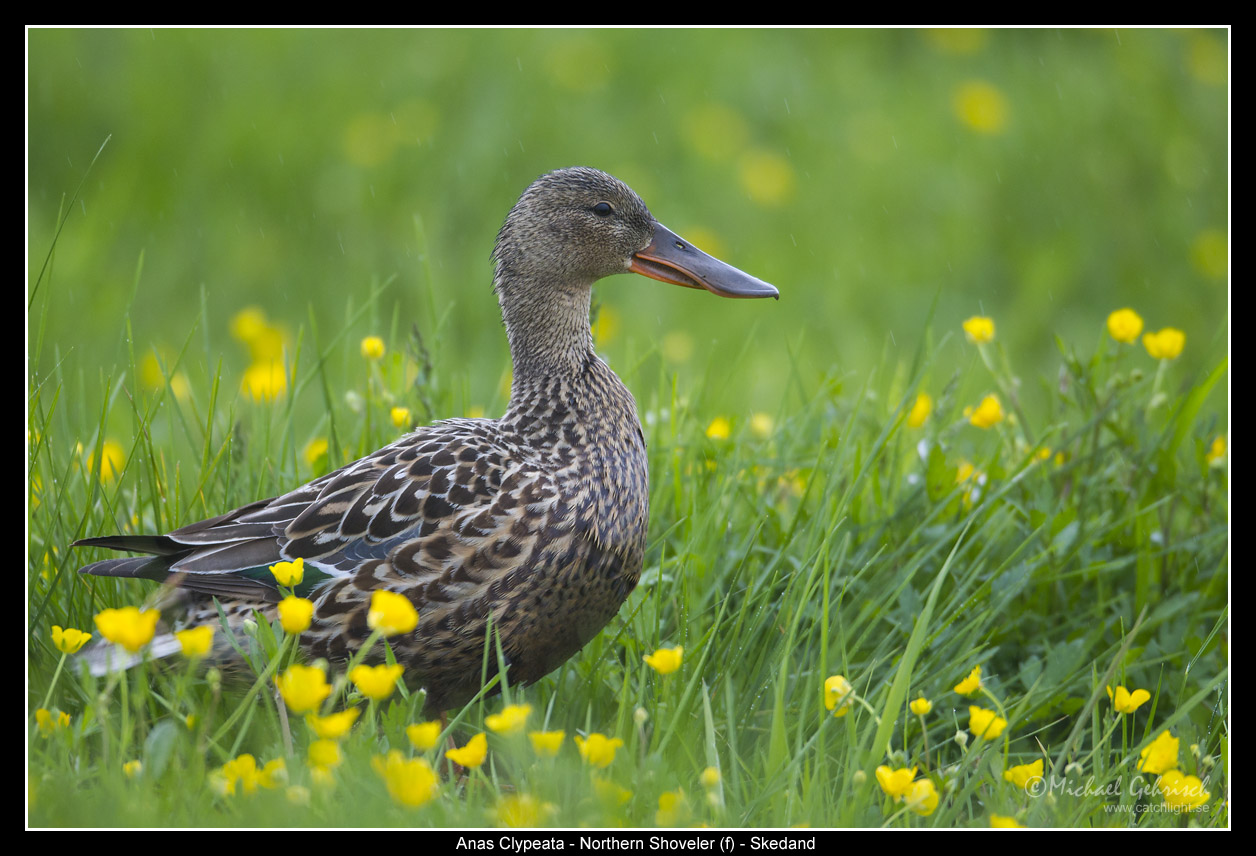
An couple of unusual visitors on the meadow was this pair of Northern Shovelers, the male's yellow eyes always makes him look like he is completely surprised, while the female looks a bit more relaxed


And as the rain starts to the lapwings three chicks run to mom and take cover under her wings, I try to move forward and back to get a better shot without the grass in the foreground, but it's no use, this is all I got...


An unusual find for me is the female hare cleaning her baby, I try to get a little closer but looked away for a few seconds, in the meantime the hare has moved away from her baby and is grazing on the grass again, and it's impossible to find the baby

As the rains comes down harder I have to cut my trip short. It's mother's day in Sweden, so I need to buy some roses and pastries for my wife and see if I can cut a deal for the safe return of my coffee mug.

Saturday, May 18, 2013

Just Another Morning on the Meadow

Despite getting up at 5:30 the sun was already high over the horizon by the time I made it out to meadows.  I was obviously late, since there was so much going on everywhere I looked. Lapwings, skylarks and wagtails chasing intruders out of their territories; crows harassing a marsh harrier as it flew over with a newly caught rat or something with a long black tail. I always tell myself I'm going to get up earlier, but at 3:30 when I checked the sunrise seemed so far away...

A yellow wagtail doing her morning stretch


A harrier lifts off with her partially eaten breakfast, maybe a rat, it had a long black tail. Yumm!


A skylark is taking his morning bath in the sand

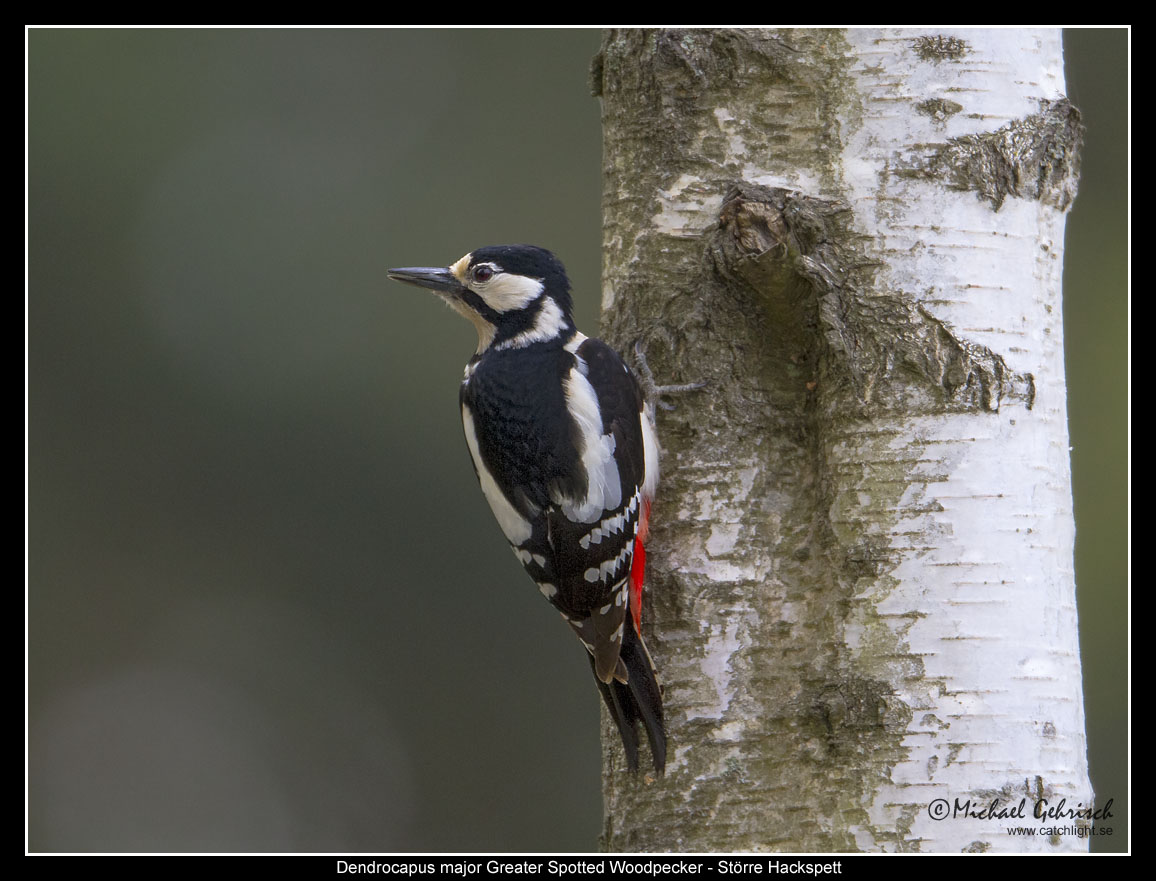
And a greater spotted woodpecker eats larvae and aphids off the tender new leaves of an oak. Hanging upside-down is no problem at all with this powerful claws.

Next Satruday I'm going to get up earlier...

Friday, May 10, 2013

The Early Bird Gets the Worm

Spring is now at it's best, trees and meadows have that lime-green shade that makes a perfect background for any shot.

The local pheasant cock is high on testosterone and fears no one, he has that look in his eye, "This is my turf, and I'm ready to fight anyone to prove it"


Meanwhile out on the meadows the curlews take turns sitting on their eggs and foraging. Their long bill is the perfect tool for finding earthworms...

Nearby the skylark is gathering material for its nest

And in the forest the woodpecker is staking his claim to a territory by drumming on the tree trunk.

The red kites are out in force, I counted ten sitting in one tree; a few at a time they fly low over the nearby meadows looking for their next meal.

It doesn't get much better than this...

Tuesday, February 5, 2013

The Canon 100-400L Turbocharger

In our bedroom closet I have 25 boxes with Kodak Carousel slide trays containing 3500 slides. Taken between 1978 and 2003, these are what's left after throwing away all the "bad" slides (probably 20,000 or so) . A few years ago my father gave me his Nikon scanner and I decided I would digitize my slides. But since going digital the bar has been raised. Of the 3500 slides I found about 100 that by my standards were worth scanning.

I can identify four things that happened to significantly improve my photography.
First was the immediate feedback of digital photography which allowed me to quickly retake bad shots until I got it right.
Second was the day I bought my Canon 100-400L lens. I know, a good photographer can take excellent pictures with any camera/lens combination, but I'm pretty sure I'm not one of those good photographers, and I have the 3500 slides to prove it.
Third was buying and using a stable tripod
Fourth was my switch to shooting in RAW format. 

As I drove home from the UPS office on March 26, 2004 with my new lens I HAD to stop and take some test shots, so I took some sunset shots and when I looked at the result I thought "Wow, this looks like National Geographic material". Of course it wasn't, but the sharpness and contrast was light years better than anything that had come out of my camera before and all of a sudden I became interested in photographing birds and nature.

Below are a handful of shots from 2004, which I took during my first six months with the 100-400 and the original Canon Digital Rebel (300D).

July; juvenile bearded tits.

May; the rapeseed blooming at Skabersjö mill.

June; a common kestrel in flight.

May; sunrise on the Öresundsbron - the bridge to Denmark, completed in 2000.

June; a mare and her foal in Österlen.

June; yellowhammer in Brantevik, Sweden

July; Foxes playing on a meadow

September; Natalie taking a sunrise dip in Lomma

Of course the Canon 100-400 has drawbacks, it weighs a ton... well 1360 grams or nearly three pounds, it's white, so not very discrete, and it is not the sharpest lens that Canon makes. So I sold my Canon 100-400 after about a year and bought a fixed focal length 500mm lens, which took better pictures, but weighed more and was not nearly as flexible. A few months later I bought another 100-400 and then sold that after a year, and again after a few months I bought another 100-400. In total I have owned five copies of the 100-400. I bought the latest one a couple of years ago, and I think I have finally decided to keep it.

If I were forced to choose a single lens, and knowing the kind of photography I do, I think I would probably take the 100-400.

Is any of this relevant for you? Maybe a couple of words of advice: There are a number of outstanding zoom lenses in varied price ranges; the Canon 70-200/4L for example is an outstanding value for an L-series. The 70-200/2.8L IS II is a fantastic lens at the other end of the scale . But at the end you have to figure out which is the right tool for the kind of photography you do. Don't be afraid to borrow, rent or buy well cared for used lenses to be able to evaluate if a lens works for your style of shooting. Used lenses keep their value and mean that you should be able to sell a lens without taking a loss if it's not quite what you expected.  The 100-400 is not for everyone, but when you find the lens that matches your style you won't let it go.

Wednesday, January 30, 2013

Natures Hovercraft...

Kestrels are some of the smallest and most beautiful falcons and occur in various species around the world, including Australia and America. You've probably seen them somewhere along a road with chestnut brown wings, hovering over a field, their typical hunting method. Photographing kestrels is usually not too difficult. Those living near populated areas are are pretty tolerant of humans, at least if you stay in your car when you are photographing. The only challenge when photographing kestrels is getting the sun and wind to cooperate, since the kestrel will always hover facing into the wind and if the wind is blowing towards the sun, the kestrel's head will be shaded. So the best conditions for photographing a hovering kestrel is shortly after sunrise or before sunset with the wind perpendicular to the direction  the sun. That will give you a well illuminated bird and if you are early enough, some light on the underside as well.
The top two pictures were taken in Falsterbo on the Southwestern tip of Sweden during the fall migration where many of the birds heading South for the winter are funneled into a small corridor before crossing the Öresund Straits and continuing on to Europe and Africa.


And here is the same bird in an animated GIF image, consisting of 16 still images, which gives a pretty good example of the kestrel in action Double-click on the image for slightly better resolution:


This kestrel is either digesting his latest meal or taking a more leisurely approach to hunting.


And this kestrel has definitely perfected his style of hunting. I photographed him for twenty minutes as he moved from fence post to fence post. Looking into the grass for any movement and then making a small hop from the fence post onto his prey. He was successful twice during the time I watched.But that's another story...

Friday, January 18, 2013

Kingfisher Squabble Animated Gif

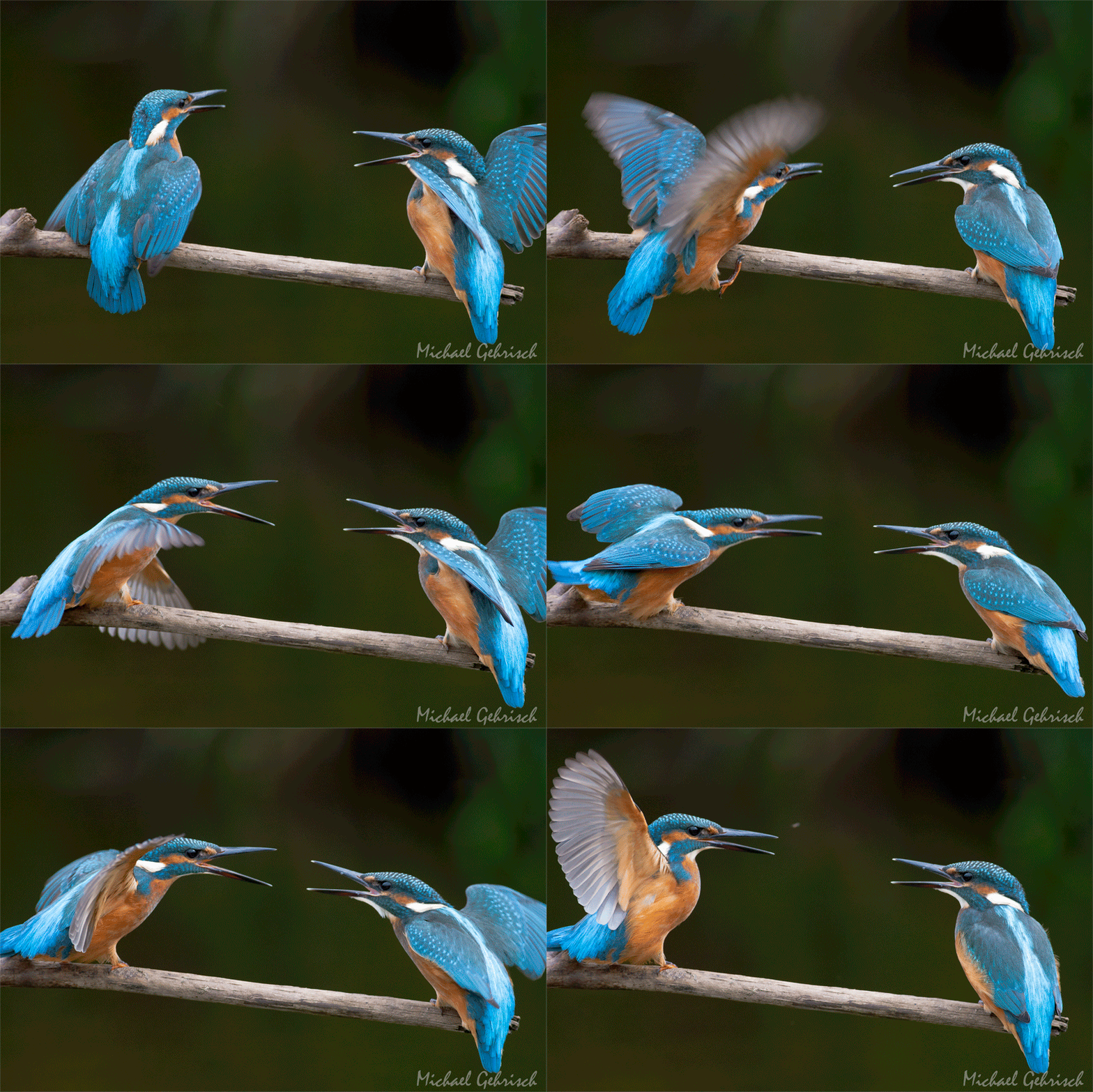
Our kingfisher session in the hide in September 2007 yielded hundreds of great images included a couple of kingfishers squabbling about who would be king of the fishing perch. And while I took a total of 16 images with the Canon 1DmkIII only a few of them were critically sharp. But I have saved all 16 images thinking there might be something I could do with them. Well I had completely forgotten about them, but them browsing through my Lightroom catalog I rediscovered them and got to thinking... How about an animated gif of the series. Said and done, below is the sixteen image clip combined into one animated gif.

Double-click on the GIF to get a slightly higher resolution.


Of course it would have been better if I had actually been filming the sequence in full HD, and I will certainly do more filming in the future, but in the mean time, it's cool to see how new technologies provides us creative ways to use our photography.

The original blog post with still images can be seen here:
http://kingfishr.blogspot.se/2007/09/kingfisher-squabble-over-fishing-rights.html

Technical image details can be found along with additional kingfisher images at
http://www.pbase.com/kingfisher/kingfishers

Tuesday, January 1, 2013

My Best of 2012

Happy New Year!

2012 was a slow year for me photographically; only 5349 images made the cut compared with 9710 in 2011. Too much work and the goal of completing the 300km VätterRundan bicycle ride in under 10 hours (finished in 9:30) did not leave enough time for photography. But there were a few high points...

The year started well with a bang in the center of Lund


Summer arrived far too quickly...


A visit to New York included plenty of new photo opps including the view from the Top of the Rock

As did a trip to Yosemite. Even though half-dome has become one of the photographed places in the world, it's pretty spectacular.
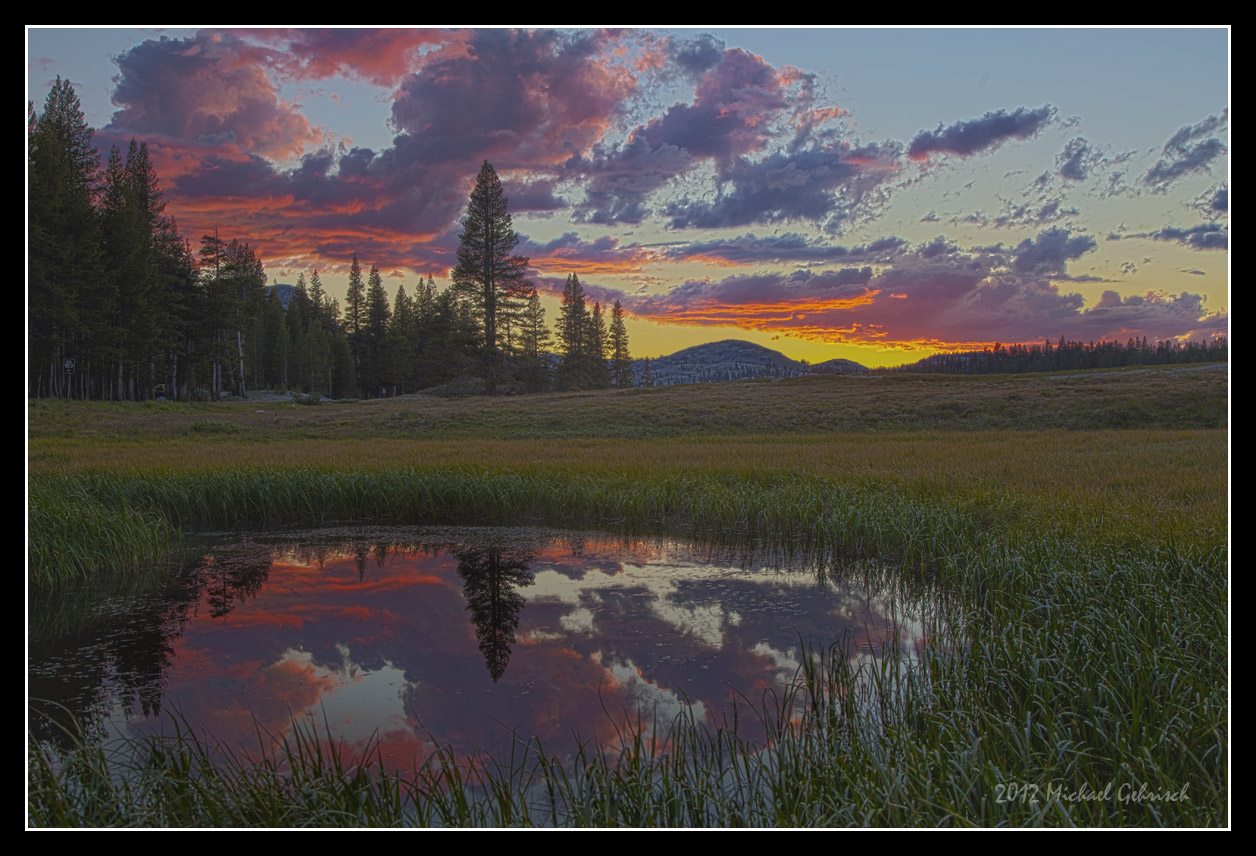
And Tuolomne Meadows provided the setting for a spectacular sunset:
Back in Sweden, it didn't take long before fall was upon us...

And all of a sudden it's 2013. Time for new goals and new adventures. This year I hope to complete the 300KM VätternRundan in under 9 hours AND spend more time photographing.
Good Luck with your resolutions and have a great 2013!

http://www.pbase.com/kingfisher